Chapter 1 · 1 of 6
What you get back
A run hands you three things you can act on — a per-work knowledge base, a runbook, and a suggested machine and toolkit — and, from the same evidence, three audience-specific views: a dependency manifest for the conservator, an asset catalogue for the researcher, and ‘the artist’s hand’ for the art historian. This is a tool for art historians as much as engineers. All of it is a proposal, flagged where it is unsure, never silently applied to the work.
You have been handed an unknown born-digital work — a zip, a disc image (a single file holding the complete contents of a CD or hard disk), a loose folder — and the questions of your first days are always the same: what is this, which file starts it, what software did it need, and what kind of machine would run it again? artwork-autopsy reads the work end to end and answers those questions on paper. It decides nothing irreversible and touches the work at no point. What it produces is a single report that fans out into three things you can pick up and use.
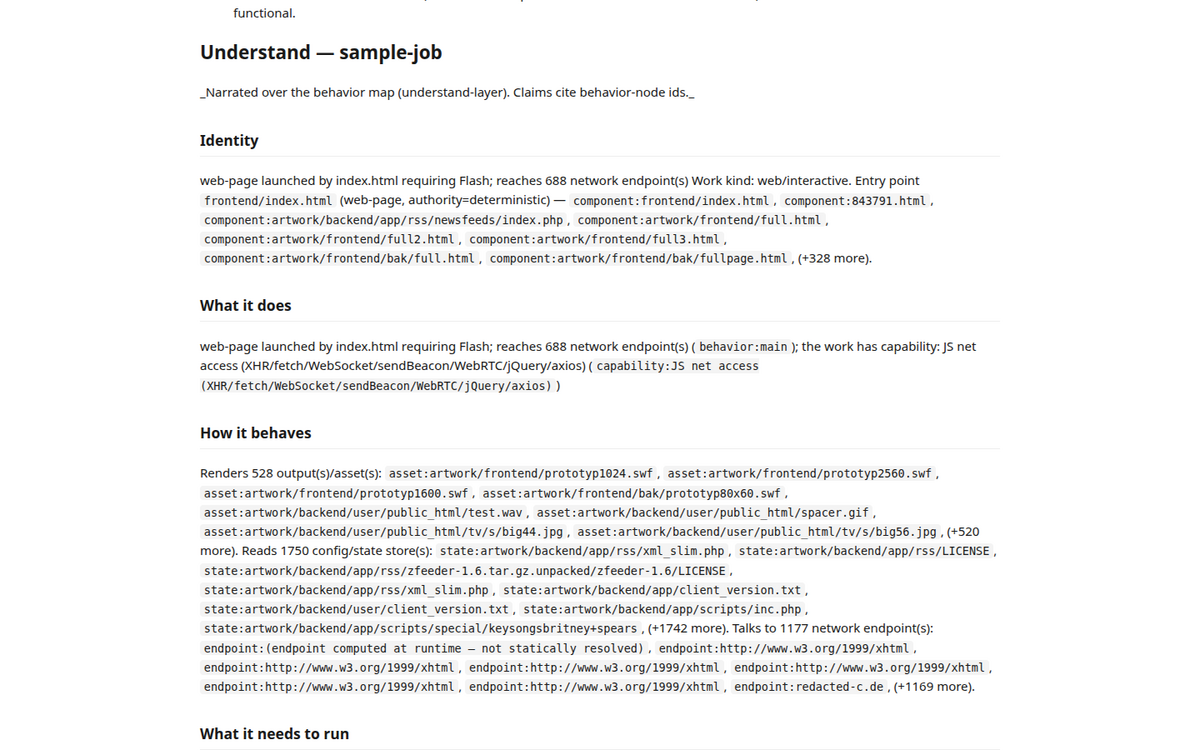
Three views on the same evidence
The report, runbook, and suggestions above are what the workbench acts on. But the same evidence also serves people who will never boot a virtual machine (a period computer re-created in software), so the analysis composes three audience-specific views — because this is a tool for art historians as much as engineers:
A proposal, never a verdict
Nothing here is presented as fact. Every line is a fallible, labelled suggestion for a person to accept, adjust, or throw out. Two rules sit underneath all of it — the same rules everyone who actually keeps old interactive media alive works by (the Internet Archive, Rhizome, the demoscene, abandonware):
- Never destroy the original. The raw bundle is kept untouched; everything produced is a derived working copy, never an edit to the work itself.
- Label what we guessed. Every automated finding is marked as a proposal, so you always know what was read from the bytes and what was inferred.